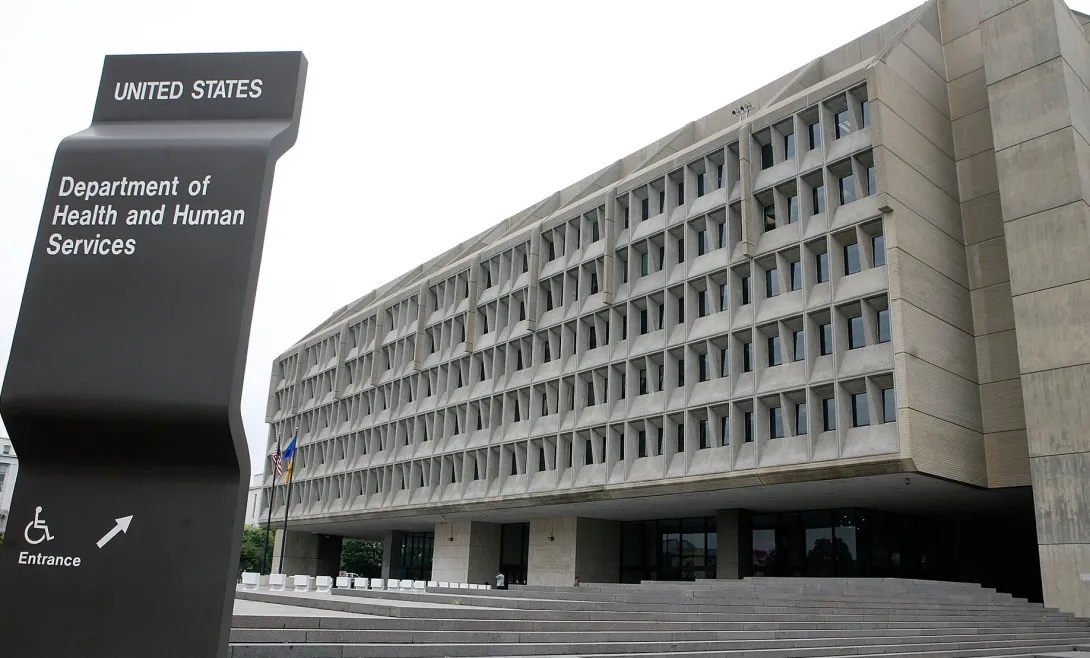
Photo: Alex Wong/Getty Images
The Department of Health and Human Services has released an AI strategy for the agency.
The goal is to make artificial intelligence available to the federal workforce and to integrate it across internal operations, research and public health, HHS said.
The department recently said that it plans to use C3 for an interagency data platform to integrate disease-specific NIH data with Medicare, Medicaid, claims and state registry datasets to improve data quality and CMS governance.
WHY THIS MATTERS
The "OneHHS" strategy invites all HHS divisions, including the Centers for Disease Control and Prevention, the Centers for Medicare and Medicaid Services, the Food and Drug Administration, the National Institutes of Health and others to collaborate in the development of one robust department-wide AI infrastructure, streamlining workflows and enhancing cybersecurity.
The strategy does not encompass integrating AI into the delivery of its services, HHS said. This first step is focused primarily on improving internal operations, efficiency and federal use as directed by the Office of Management and Budget.
It also paves the way for engagement with private-sector stakeholders to co-create solutions that maximize the potential of AI, HHS said.
The five pillars of HHS' AI Strategy will be revisited and updated as necessary to optimize AI across the department, HHS said. The pillars are: ensuring governance and risk management for public trust; designing infrastructure and platforms for user needs; promoting workforce development and burden reduction for efficiency; fostering health research and reproducibility through gold standard science; and enabling care and public health delivery modernization for better outcomes.
THE LARGER TREND
Led by the HHS acting Chief Artificial Intelligence Officer Clark Minor, the HHS AI Strategy delivers on the Trump administration's AI Action Plan, AI-related executive orders and guidance from the Office of Management and Budget (OMB).
ON THE RECORD
"AI has the potential to revolutionize healthcare and human services, and HHS is leading that paradigm shift," said Deputy Secretary of Health and Human Services Jim O'Neill. "By guiding innovation toward patient-focused outcomes, this administration has the potential to deliver historic wins for the public — wins that lead to longer, healthier lives."
Email the writer: SMorse@himss.org