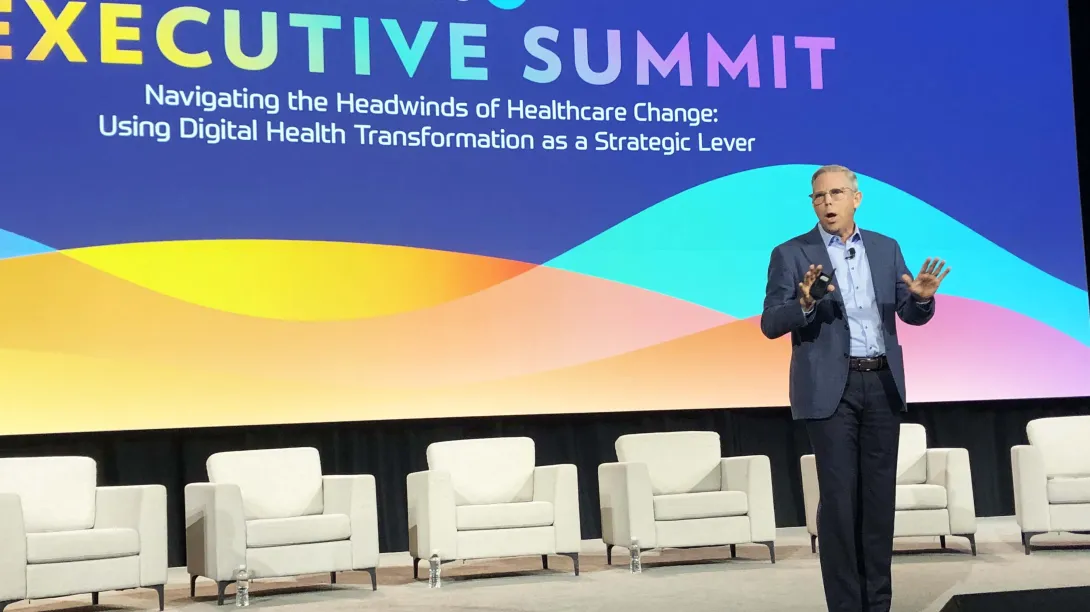
David Banks, president and CEO of AdventHealth
Photo: Susan Morse/HFN, HIMSS
LAS VEGAS – HIMSS President and CEO Hal Wolf and keynote speaker David Banks, president and CEO of AdventHealth, threw down the gauntlet, challenging the industry to confront the headwinds healthcare is facing during the Executive Summit Monday at the 2026 HIMSS Global Health Conference & Exhibition here.
"Change is the key," Wolf said. "This is an extraordinary change management moment."
Healthcare is in a good position in that the technology is there and plenty of money is being invested, Banks said.
But investors, including the federal government, expect to see results from their investment, and that isn't always there.
Dr. Mehmet Oz, administrator for the Centers for Medicare & Medicaid Services – who is scheduled to appear at HIMSS26 later this week – has told Banks directly that he's never seen so much money spent without getting the resulting productivity from it.
They're spending the money, and they don't think we're meeting the expectations, Banks said.
Expectations of getting ROI from investment, especially from AI, became a theme of the summit's Monday morning sessions.
Battling the headwinds was the theme of Banks' talk as Wolf kicked off the Executive Summit's "Leading Healthcare's Perfect Storm: Addressing the Headwinds of Systemic Change."
There are many challenges, Wolf acknowledged, including a workforce shortage that is expected to get worse.
The World Health Organization has said there will be a gap of 10 million to 15 million positions in the clinical domain by 2030, he said. In the United States alone, a 700,000-position gap is estimated by 2037.
One in two healthcare workers are looking to leave this ecosystem because the pressure is too great and they don't see development support, Wolf said.
"We're up against massive shortages, so digital health is going to play in here," Wolf said. "People, process and technology have to be combined."
Banks asked, "Does a headwind have to result in total disruption?"
There are two responses to headwinds, Banks said. The first is one of complacency and maintaining the status quo.
The second response is to mobilize and harness what is possible. The group responding this way is solid in its purpose.
Banks said he has been talking with staff about pragmatism. The ER sees about 200 people a day. The pragmatist says, "Do the best you can," Banks said.
But the ER will see 200 people today and another 200 people tomorrow.
The goal is to "hit the mark," he said, so that each person has the best experience.
Expect the headwinds, but don't let it be a total disruption.
"Surviving the headwind is not the goal," Banks said.
The strategy is to reposition the organization to get to the goal.
"Identify one thing to do to win," Banks said. "Positioned to win. What do we need to do today?"
AdventHealth, which has more than 50 hospitals in nine states, has made a $60 million investment in partnership with hellocare.ai in AI-assisted virtual care delivery. This will be across AdventHealth's more than 13,000 inpatient and emergency department beds, enabling enhanced monitoring and giving clinicians an AI-assisted virtual care platform, according to hellocare.ai.
Email the writer: SMorse@himss.org