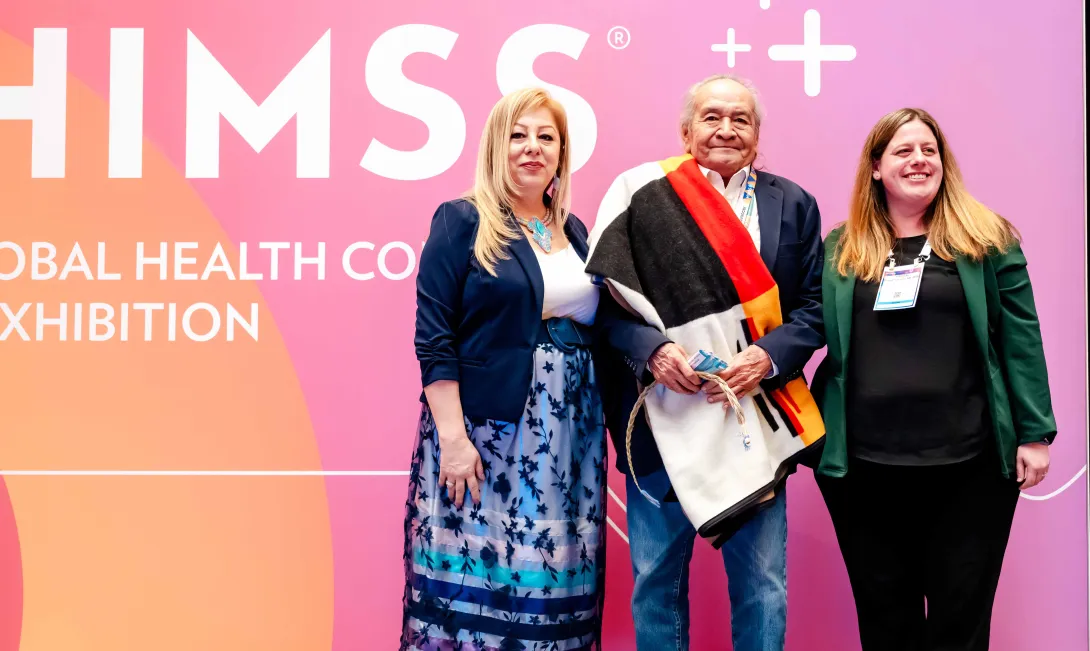
From left: Brenda Hood, with HealtHIE Nevada (HIE) and the Nevada HIMSS Tribal Liaison for the HIMSS Native American and Indigenous Community; Wallace Coffey, former chairman of the Comanche Nation; and Krystal Schramm, Michigan HIMSS Tribal Liaison and vice chair of the HIMSS Native American and Indigenous Community, attend the HIMSS25 Native American Symposium at the annual Global Conference.
Photo: HIMSS
Healthcare data sharing is central to the Trusted Exchange Framework and Common Agreement (TEFCA), but to the Native American community, the exchange of information has challenges beyond the current implementation of a new electronic health record for the 574 recognized Tribes in the United States.
Tribal members are hesitant about sharing data, said Krystal Schramm, Michigan HIMSS Tribal Liaison and vice chair of the HIMSS Native American and Indigenous Community.
“It’s very difficult with years of distrust with the government to move forward with health IT,” Schramm said.
“It’s one of the biggest barriers,” said HealtHIE Nevada (HIE) Client Experience Analyst Brenda Hood, who is also the Nevada HIMSS Tribal Liaison for the Native American and Indigenous Community. “What I experience in Nevada, they are very hesitant when they hear data sharing. They’re trying to be more protective of their communities.”
Another ongoing issue is the question of data ownership.
Data use agreements with states mean Tribal communities need permission to access their own data. Tribes want to end this paternal relationship, said Marcelino C. Flores, Tribal Liaison, Pima County Health Department in Arizona.
“We need to get away from that,” Flores said. “Sometimes we fall between the cracks because of data suppression.”
Two months ago, Arizona hired a Tribal state epidemiologist. Flores became the Native American specialist at the Maricopa County Health Department.
“We’re just beginning to turn toward collaboration,” Flores said.
Progress is being made, said those interviewed, though it is often slow and varies by state.
“We’ve made progress in Michigan,” Schramm said. “It starts with the Tribe trying to get the data. It has to go to the state’s legal team and data sharing agreements. Tribes are their own public health entities.”
Advocating for 574 federally recognized American Indian and Alaska Native Tribes is the National Indian Health Board, a nonprofit, non-governmental organization.
The Indian Health Service is a federal agency of the Department of Health and Human Services. The IHS places and pays for clinics on reservations. Care for those who live on the reservation is paid under the IHS. If a higher level of care is needed at a hospital off of the reservation, the Indian Health Service has to approve the cost.
Tribal communities can also run independent clinics but must have their own funding to support them.
In 2024, the Indian Health Service announced at HIMSS24 that it had awarded Oracle the contract to upgrade the electronic health record across the 574 federally recognized Tribes. Work began this year in Oklahoma to replace technology that in some cases is over 40 years old.
The HIMSS Native American and Indigenous Community has grown, as well as the populations included. The number of HIMSS Chapter Tribal Liaisons has increased from three to eight, and they are now in Hawaii-Alaska, Oklahoma, Michigan, Montana, Nevada, New Mexico and Washington. The number of members in the HIMSS Native American and Indigenous Community has grown to more than 300. HIMSS is the parent company of Healthcare Finance News.
“I have a lot of faith in this group,” Hood said.
“What I’m most excited about is the momentum,” Schramm said. “I feel that we had a turning point this year from going from three to eight tribal liaisons. HIMSS has helped be a platform. … Bringing us together in a group has been very helpful.”
HIMSS plays a role in advocacy and education, said Evan Dunne, former Government Relations manager at HIMSS.
HIMSS is able to advocate at the Capitol for adequate federal funding and also on policy, Dunne said.
“Another perspective is around education,” Dunne said. “A lot of times Tribes and Tribal health are left out of policy discussions. It exacerbates equity conversations. We want to make sure Tribes are part of the discussion.”
Part of that is the day-long symposiums held annually during the HIMSS Global Conference.
The first Native American Health IT Symposium was held at the HIMSS Global Conference in 2024. Since then, HIMSS has expanded the Native American and Indigenous Community to include Alaska, Canada and aboriginal Australia.
The third symposium, called the Native American Indigenous Symposium, will be held Monday, March 9, 2026, from noon to 5 p.m. at HIMSS26 in Las Vegas.
“We’re elevating Tribal health,” Dunne said, “sharing best practices for data sharing frameworks that respect Tribal sovereignty.”
Issues related to data exchange, closing gaps in care and the rural nature of Tribal healthcare also get heightened awareness in November during Native American Heritage Month.
“Really, it is a time to go back and remind ourselves where we came from and the work we do everyday,” Schramm said. “It’s a good way to focus on the communities we work with. All of us play a role in that. We bring that voice to the table – in things like health IT, advocacy, bringing that Tribal advocacy role out.”
“It’s about eliminating gaps in healthcare and providing the knowledge they need to be aware of,” Hood said.
“Native American Heritage Month,” Flores said, “is a celebration that we’re still here.”
Email the writer: SMorse@himss.org