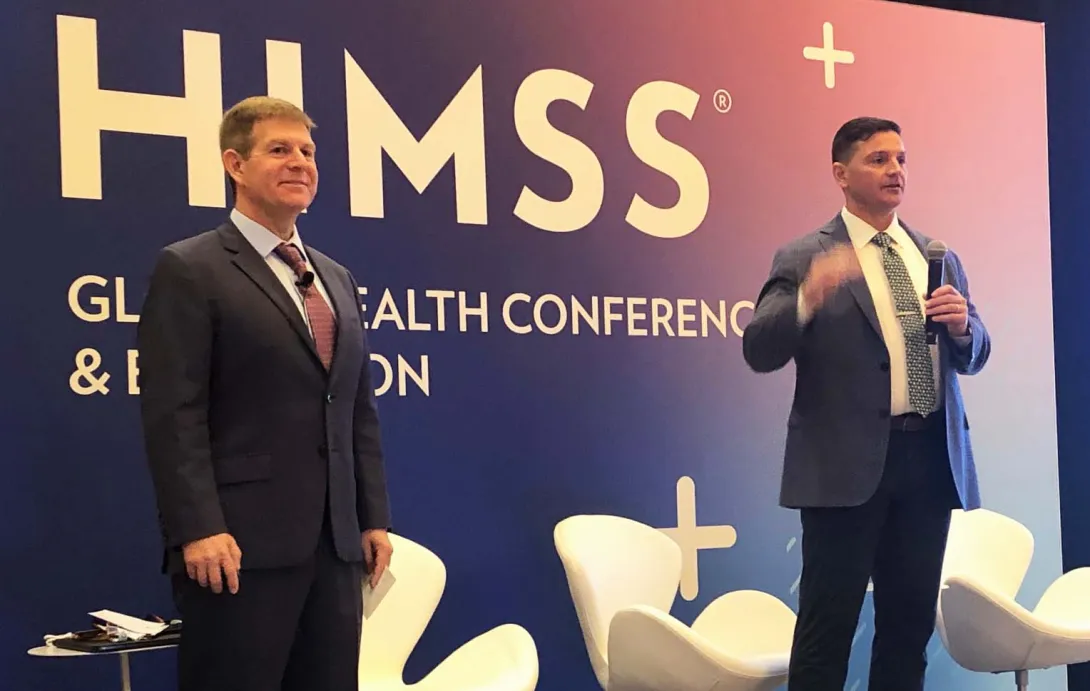
Dr. Brian Silverstein of Innovaccer and Andrew Albano of Atlantic Health and the Atlantic ACO
Photo: Susan Morse/HFN, HIMSS
LAS VEGAS – The Medicare Shared Savings Program has been one of the most successful programs established by the Centers for Medicare & Medicaid Services to improve quality and save costs.
The voluntary program was established through the Affordable Care Act 14 years ago as an alternative payment model that is the essence of value-based care. Physicians, hospitals and providers form Accountable Care Organizations (ACOs).
There are currently 476 ACOs in MSSP, according to speakers at the Payer Forum "Embedding Clinical Intelligence to Transform Medicare Shared Savings Program outcomes at Scale," held here March 10 at the 2026 HIMSS Global Health Conference & Exhibition.
The financial impact to his system's ACO has been $15 million in additional MSSP shared savings in 2024, according to Andrew Albano, vice president Atlantic Health and president of the Atlantic ACO.
There's been $1 million in additional quality-based incentives. ROI was positive within the first full performance year, Albano said.
The success was possible through a pairing with tech partner Innovaccer, a company that uses AI to unify fragmented patient data across systems.
But integrating clinical intelligence into workflows is not without its challenges. It adds time to physicians' schedules.
Healthcare is one of the few areas where technology adds time, said Dr. Brian Silverstein, chief population health officer at Innovaccer.
The questions become, can MSSP performance be improved without adding physician burden? Is it possible to integrate intelligence across more than 120 different EHR systems?
Patient attribution is also a thorn. This is the process by which patients and their medical costs are assigned to a physician or entity.
Also, every payer has its own quality metrics.
It's a complicated system, Silverstein said, and performance-based care delivery is not going to happen overnight.
Health systems need to find a way to reduce administrative burden, as physician burnout affects 45-50% of clinicians, Albano said.
High performers get near-real-time data integration, embed clinical intelligence in real-time workflows, involve physicians in co-design decision support and automate identification of documentation opportunities, he said.
The Atlantic Health and Innovaccer partnership has resulted in 22.1% more quality care gaps closed, according to Albano. Having clinical intelligence, he said, has been a way for various parties to share in care delivery and move in a direction that optimizes health outcomes and drives savings.
Atlantic Health, a system of seven hospitals based in Morristown, New Jersey, has the accountable care organization Atlantic ACO and is also associated with the Optimus ACO and the Premier ACO for more than 81,000 lives in the Medicare Shared Savings Program.
Email the writer: SMorse@himss.org