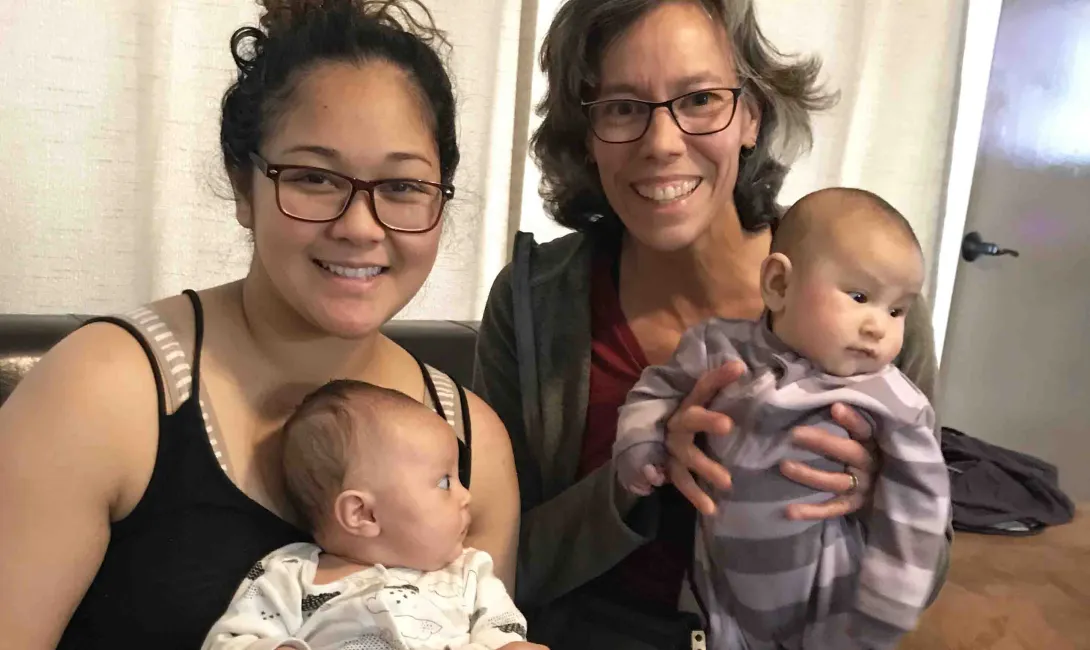
Marjourie Solano and Heather Preece of Kodiak KINDNESS with infants in the program.
Photo: Courtesy of Kodiak KINDNESS
Kodiak Island is an isolated but large land mass in the Gulf of Alaska that records about 100 births a year. It's home to the U.S. Coast Guard Base Kodiak and the nonprofit Kodiak KINDNESS, the Kodiak Infant Nutrition and Development Support and Survey.
Kodiak KINDNESS provides infant feeding support to parents who live on Kodiak Island. Its 90% enrollment rate includes Coast Guard families, Alaskan natives and Hispanic and Filipino families.
Workers in the program lend out breast pumps and baby scales and answer questions about infant feeding and when to start children on solid foods. Most of all, they provide community support when access to a physician, clinic, hospital or even a neighbor on the 100-mile-long island is out of reach.
The support, said Program Services Coordinator Jennifer Sheridan, who used the program as a new mom, "ties into the physical and mental health of the community."
Kodiak KINDNESS operates on a $150,000 annual budget in a contract with the state of Alaska. Many on the small team, even founder Heather Preece, are volunteers. The executive director is Stephanie Mason. All have specialized training and certification.
Kodiak KINDNESS could use some of the $272 million Alaska received from the $50 billion federal Rural Health Transformation Program. All states received funds from the program. Alaska received the second-highest state allocation after Texas. Preece said she and the state remain in discussions about allocations.
The five-year funding program is meant to help states implement strategies to improve care delivery, support providers and advance new approaches to coordinating healthcare services across rural communities. It is not geared toward sustaining operating budgets.
The funding was included in the One Big Beautiful Bill Act last year due to lawmakers' concerns over the impact to rural communities from cuts in Medicaid funding.
NPR recently reported that the funding could have negative consequences for some rural communities if one of the goals of right-sizing services leads to downsizing.
What Kodiak KINDNESS wants to do with the funds is expand its outreach.
"We're going year-to-year on a shoestring budget," Preece said.
The group holds annual fundraisers such as a baby race and a milk run. Clients are not charged directly or through their insurance.
"We put a lot of time and energy into community fundraising events," Preece said.
Until the news was released for the potential for additional funding from the Rural Health Transformation Program, Preece and others just hoped they would have money to go another year.
One area for the funding would be to expand TigerConnect, a HIPAA-complaint platform for calls and messaging through smartphones, which are used for outreach.
Kodiak KINDNESS previously operated under Providence Health & Services. It went out on its own in 2021 so the community of Kodiak could own the program, Preece said.
"The opportunity to have more than one year of funding," Preece said, "we're super excited. But KINDNESS will go on, regardless of budget."
"We are health professionals," Sheridan said. "By meeting people where they are, in their homes, coffee shops, we're not constrained by clinic or office hours. The support we provide is of support to families."
Email the writer: SMorse@himss.org