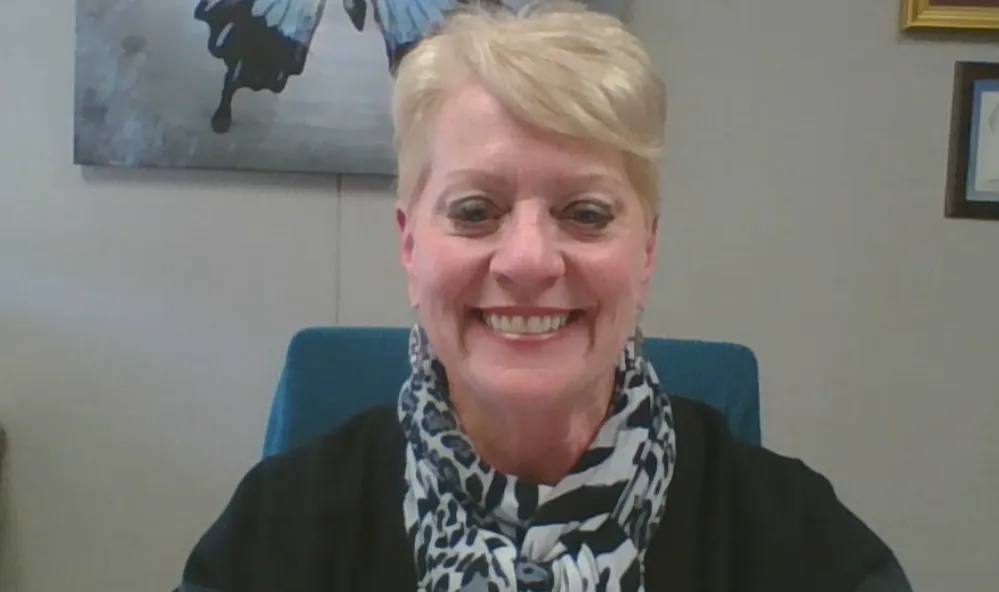
Kimberly Landers, RN, vice president of Patient Care and chief nursing executive at Morris Hospital
Photo: Screenshot/Susan Morse
Morris Hospital in Illinois is only 60 miles southwest of Chicago, but the rural, independent hospital has little relation to the larger resources of a health system in a bigger city.
It did go through the same challenges of any hospital during COVID-19 and its aftermath, including an exodus of nurses and other clinical staff. Morris Hospital lost 44% of its clinicians, said Kimberly Landers, RN, vice president of Patient Care and chief nursing executive at the hospital.
How the hospital turned this around is the basis of Landers' session at the 2026 HIMSS Global Health Conference & Exposition, taking place in Las Vegas in March.
“I’m going to tell our story, what we went through, talk about how we rebuilt,” Landers said. “In this tiny, 89-bed hospital, we took quite a hit.”
In the middle of its recovery, the hospital suffered a cyberattack and implemented a new Meditech system in its EHR.
The hospital serves patients in five counties surrounding Morris, Illinois. It doesn’t have deep pockets to implement system-wide AI solutions, though using artificial intelligence for physician notes has been very successful, she said.
“There are no plans for nursing and AI at this point,” Landers said. “That’s hugely expensive for a small place.”
What Landers did was to listen to nurses to implement changes that served them and the hospital.
“We’ve been able to reduce spend by a million a year since COVID,” she said.
Solutions included more flexible schedules beyond 8- and 12-hour shifts. Morris added 4-, 6- and 10-hour shifts.
Money was put into retention bonuses and time-and-a-half plus $40 for staff that worked during Christmas Eve or Christmas.
A new focus was put on wellness needs, including having a mental health break room. The hospital also offers staff free membership to the local YMCA and gives financial incentives for meeting wellness goals such as weight loss.
Even the dress code was changed.
“We did a lot in a very short time,” Landers said. “We really invested in our professionals.”
Landers continues to listen to nurses, meeting every new hire and holding “stay interviews” with them after they’ve been on the job for a few months.
“Most nurses want a manager emphatic to work/life balance,” she said.
Nursing is a very hands-on job. For most, working from home is not an option.
“There’s no such thing as a virtual nurse,” Landers said.
Landers will speak at “Prescription for Wellness: Strategies to Retain, Recruit and Support Nurses,” scheduled for Tuesday, March 10, at 2:15 p.m. at HIMSS26 in Las Vegas.
Email the writer: SMorse@himss.org