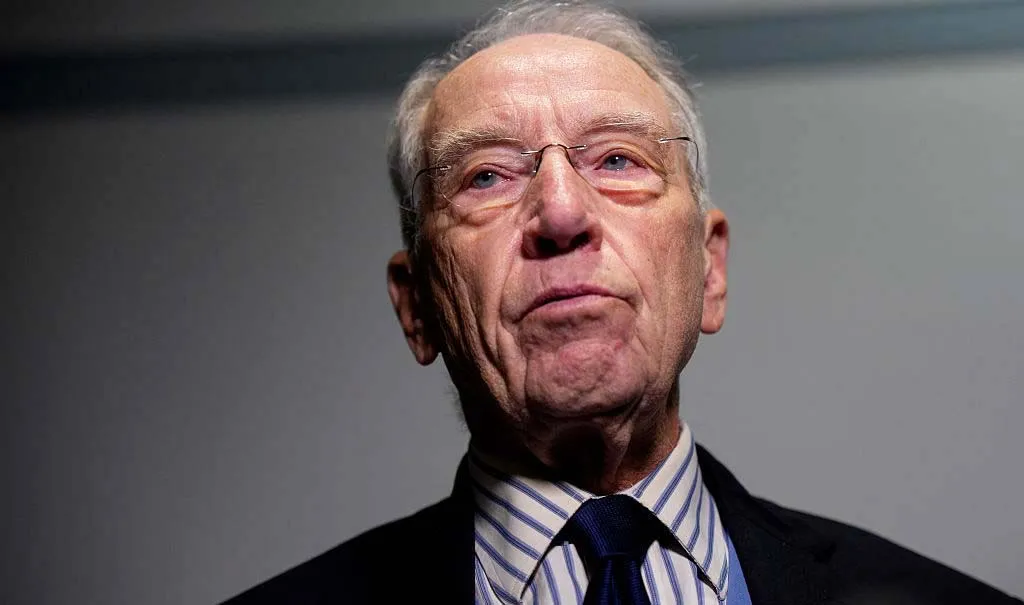
Sen. Chuck Grassley, R-Iowa, chairman of the Senate Committee on the Judiciary
Photo: Andrew Harnik/Getty Images
Sen. Chuck Grassley, R-Iowa, chairman of the Senate Committee on the Judiciary, has released a majority staff report that claims UnitedHealth is gaming the Medicare Advantage system and turning risk adjustment into its own business.
This is siphoning off taxpayer money in breach of the program's original intent, according to a statement released by Grassley's office on Monday.
The report, "How UnitedHealth Group Puts the Risk in Medicare Advantage Risk Adjustment," is based on a review of over 50,000 pages of UnitedHealth Group documents that were provided in response to Grassley’s requests, including internal training materials, policies, software documentation and audit tools.
UnitedHealth responded: “We regularly engage with CMS, the committee and others on ways to improve programs that keep seniors healthier and more independent and look forward to continuing to work together. We do, however, disagree with the committee’s characterizations of our Medicare Advantage coding practices and HouseCalls program. Our programs comply with applicable CMS requirements and have, through government audits, demonstrated sustained adherence to regulatory standards.
"Our programs are subject to rigorous clinical quality controls and compliance safeguards," the UnitedHealth response continued. "We are proud of the compassionate care our HouseCalls clinicians deliver to seniors every day. We remain focused on continuing to deliver lower costs, better access and higher-quality care for the people we serve, including those in Medicare Advantage."
In conjunction with its statement, UnitedHealth Group released its own reports on the value of Medicare Advantage to the federal government and cost comparisons across MA coverage options for beneficiaries.
WHY THIS MATTERS
The report's main allegation is that UnitedHealthcare captures a higher number of diagnoses and diagnosis codes than other Medicare Advantage organizations (MAOs), resulting in higher payments from the Centers for Medicare and Medicaid Services than its peers.
The insurer does this by using "aggressive strategies" to maximize risk adjustment scores, according to Grassley.
As the company sells its insights and workforce to other MAOs, UnitedHealth's actions in response to CMS changes to the risk adjustment model can rapidly permeate the entire MA industry, he said.
MAOs are paid based on MA risk adjustment and receive more for sicker enrollees. Enrollees with more diagnoses generally have higher risk scores and generate higher relative monthly payments for MAOs.
MAOs with more resources and superior strategies like UHG can capture more diagnoses and diagnosis codes to receive higher payments than less-resourced organizations, the report said.
One charge is around the company's practice of having nurse practitioners visit enrollees in their homes to assess current health status through in-home health risk assessments. The in-home providers capture diagnoses used to maximize risk scores and also screen enrollees for conditions using point-of-care technologies, according to the report.
"UHG appears uniquely suited to continuously identify new opportunities to capture untapped risk score-garnering diagnoses, due to its enhanced data assets, AI capabilities and clinical documentation expertise," Grassley said. "With no universally recognized, clear-cut criteria for defining many diagnoses and codes, it is difficult to determine if the criteria perpetuated by UHG is appropriate."
When, in 2014, CMS removed dementia from its list of codes (CMS-HCC), partly due to concerns over upcoding and then reintroduced the code in 2020, researchers found that "annual incident dementia diagnosis rates in MA increased by 11.5%" relative to traditional Medicare, according to the report.
THE LARGER TREND
Grassley chaired the Senate Finance Committee in 2003 when MA became law.
Last February, Grassley wrote to UnitedHealth to get information on the company's Medicare billing practices, after The Wall Street Journal ran an article on Feb. 21, 2025, that said the insurer was recording diagnoses to get extra payments.
In a reply to Grassley on March 4, 2025, UnitedHealthcare CEO Tim Noel said the February WSJ article was "deeply flawed."
In July 2025, UnitedHealth acknowledged a federal probe by the U.S. Department of Justice into its Medicare Advantage practices.
ON THE RECORD
"Medicare Advantage is an important option for America's seniors, but as the program adds more patients and spends billions in taxpayer dollars, Congress has a responsibility to conduct aggressive oversight," Grassley said. "Bloated federal spending to UnitedHealth Group is not only hurting the Medicare Advantage program, it's harming the American taxpayer. My investigation has shown UnitedHealth Group appears to be gaming the system and abusing the risk adjustment process to turn a steep profit. Taxpayers and patients deserve accurate, clear-cut and fair risk adjustment processes.”
Email the writer: SMorse@himss.org