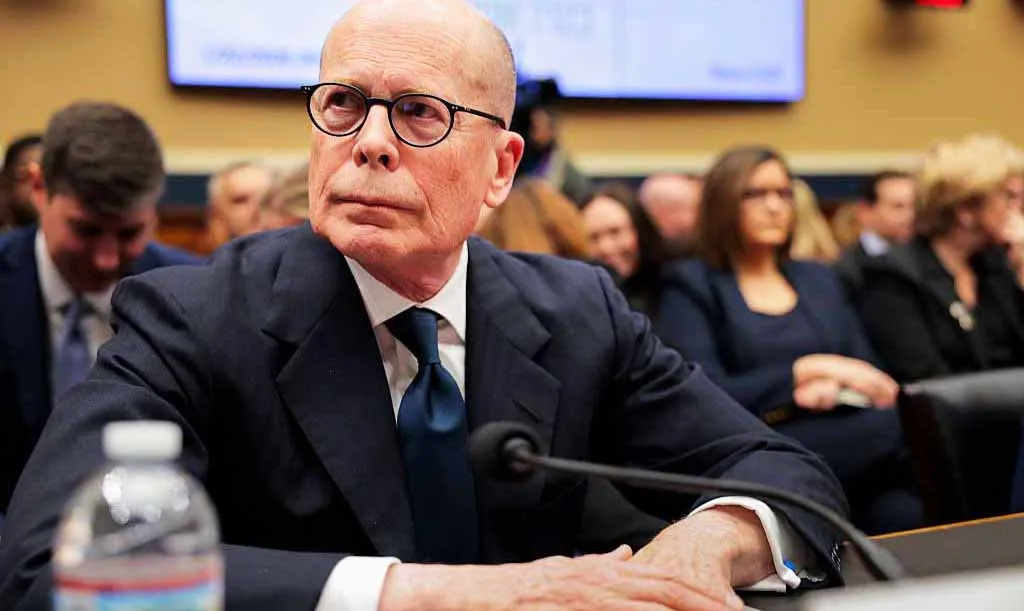
UnitedHealth Group CEO Stephen Hemsley testifies Thursday before the House Energy and Commerce Committee Health Subcommittee.
Photo: Heather Diehl/Getty Images
UnitedHealth Group will rebate profits made from its Affordable Care Act plans to customers, Chairman and CEO Stephen Hemsley said in a prepared statement before a House Energy and Commerce Health Subcommittee today.
"Though UnitedHealthcare is a relatively small participant in the individual ACA market, we will voluntarily eliminate and rebate our profits this year for these coverages, as Congress continues to work toward more long-term solutions," Hemsley said in a prepared testimony.
Executives from Cigna, CVS Health and Elevance Health were also slated to testify, according to Seeking Alpha.
The hearing, “Lowering Health Care Costs for All Americans: An Examination of Health Insurance Affordability,” was held by Congressman Brett Guthrie, K.Y.-02, chairman of the House Committee on Energy and Commerce, and Congressman Morgan Griffith, Va.-09, chairman of the Subcommittee on Health.
“Our constituents are feeling the effects of damage caused by Democrats’ failing healthcare policies, which have delivered worse health outcomes for patients by reducing choice and making care unaffordable and inaccessible. Now, they are doubling down, causing the rapid rise of healthcare costs,” said Guthrie and Griffith by statement. “Republicans have proposed many solutions to address this broken system, and this hearing is just the first step toward a larger effort to address the healthcare affordability crisis. We are working diligently to improve health outcomes and decrease the cost of care for all Americans.”
Democrats have proposed extending the enhanced premium tax credits that have lowered the cost of premiums for an Affordable Care Act plan. A three-year extension passed in the House before the December recess, but the Senate punted on taking any action until January.
Then, on Friday, President Donald Trump released the “Great Healthcare Plan,” which would give money directly to consumers’ health savings accounts instead of to insurers. The plan has no extension of the Affordable Care Act premium subsidies that ended on Dec. 31, 2025.
Without the subsidies, premiums in ACA plans were expected to double, with many dropping coverage.
On Jan. 15, at the end of ACA open enrollment, the Centers for Medicare & Medicaid Services released marketplace enrollment numbers that showed 1.4 million fewer members this year compared to last year. As of Monday, total enrollment was 22.8 million consumers, compared with 24.2 million members last year, a 5.8% decrease.
On Thursday, the Johns Hopkins Bloomberg School of Public Health held a briefing on the Health Insurance and the Affordable Care Act, with Gerard Anderson, a professor, and Elizabeth Fowler, a distinguished scholar. Both are in the Department of Health Policy and Management at the Johns Hopkins Bloomberg School of Public Health.
The president’s approach of giving money directly to people is not the same as providing health coverage, Fowler said. For patients undergoing treatment for cancer, the cost is thousands of dollars. A health savings account won’t cover the cost of such expensive care, she said.
Costs are going up across the system for all payers, they said.
Premium increases are due to the growing cost of healthcare, at about 7% to 8% a year, Anderson said. Insurers have to increase their rates as costs go up.
“They’re concerned people will drop coverage, so they have to build that in the rates,” Anderson said.
Those who drop out of an ACA plan and go uninsured tend to be the healthier individuals. Those who are sicker and need immediate coverage remain. This means premiums are rising by an estimated 10%, he said.
For hospitals, it means providing uncompensated care or trying to “pass through” these costs, Anderson said. Most likely these costs are passed on to people who have insurance, which in turn increases their insurance rates.
The issue is not unique to the ACA, Fowler said.
Insurers do what they can to mitigate increases by shifting costs to other levels of coverage in the ACA, Fowler said. But several large insurers have dropped their earnings estimates.
UnitedHealth Group is scheduled to release its full-year 2025 financial results and provide 2026 financial guidance on Tuesday, Jan. 27, at 8 a.m. ET.
Email the writer: SMorse@himss.org